
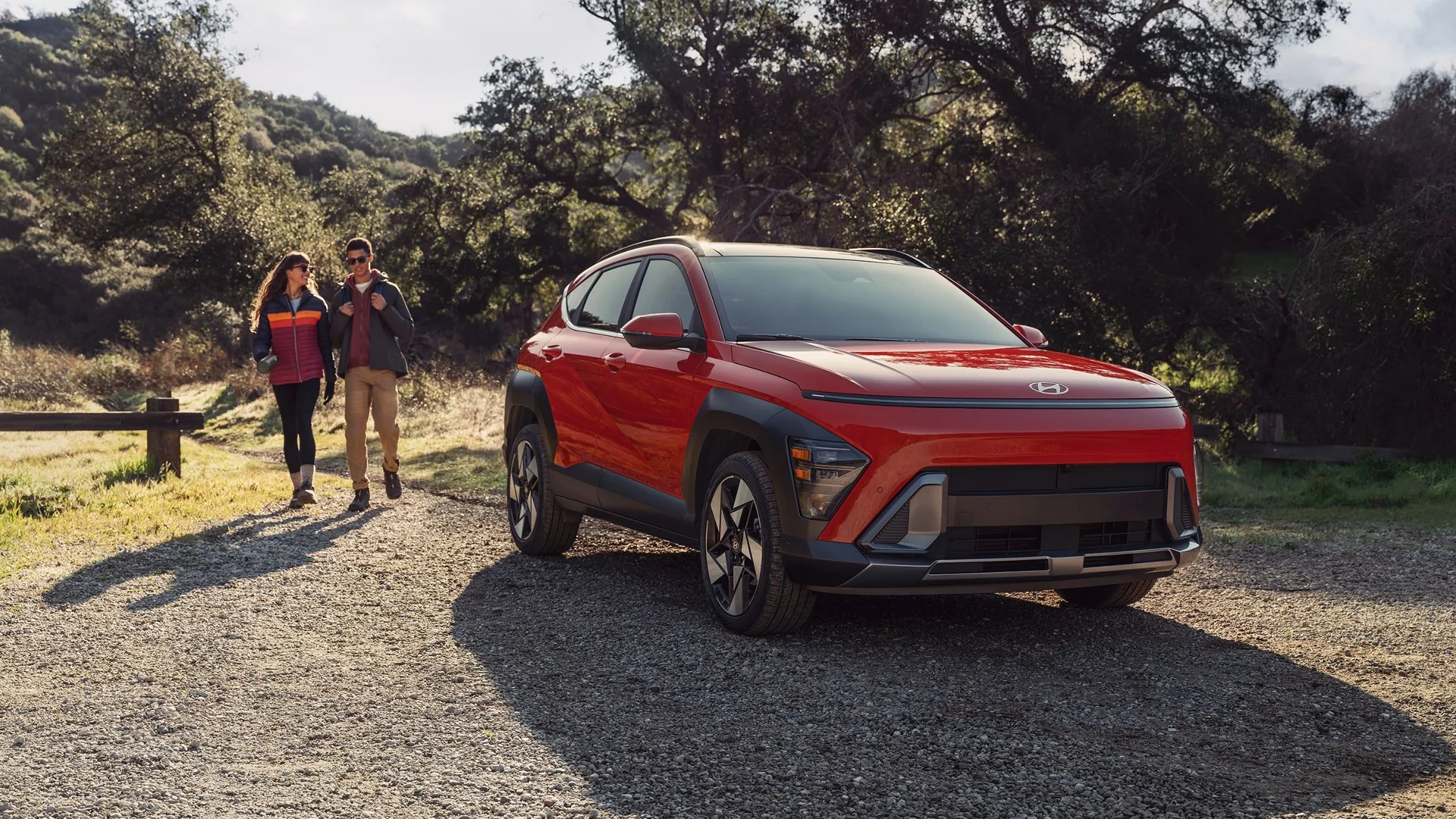
The 2026 Kona SE and SEL Sport get 31 MPG combined with FWD, 34 MPG on the highway. The turbocharged SEL Premium and Limited get 28 MPG combined FWD. AWD is available on all four trims for $1,500 and costs 2 to 3 MPG. Here is the full breakdown by trim.
2026 Hyundai Kona Fuel Economy by Trim
Four gas trims, two engine families. The naturally aspirated 2.0L trims lead on efficiency; the turbocharged 1.6T trims lead on power.
| Trim | Starting MSRP | Engine | FWD MPG (city/hwy/comb) | AWD MPG (comb) |
|---|---|---|---|---|
| 2.0L Naturally Aspirated — CVT Automatic | ||||
| SE Best MPG | $25,500 | 2.0L NA / CVT | 29 / 34 / 31 | 27 / 29 / 28 |
| SEL Sport Best MPG | $26,825 | 2.0L NA / CVT | 29 / 34 / 31 | 27 / 29 / 28 |
| 1.6L Turbocharged — 8-Speed Automatic | ||||
| SEL Premium | $28,425 | 1.6T / 8A | 26 / 31 / 28 | 25 / 28 / 26 |
| Limited | $32,650 | 1.6T / 8A | 26 / 31 / 28 | 25 / 28 / 26 |
AWD (Hyundai HTRAC) is available on all four trims for an additional $1,500. Prices are starting MSRP before destination, options, taxes, and fees; confirm at time of purchase. EPA-estimated MPG; actual mileage will vary with driving conditions, speed, and load. Source: fueleconomy.gov. View current Kona inventory at Sport Durst Hyundai in Durham.
Kona MPG Questions, Answered for Triangle Drivers
What drives the difference between trims, what AWD costs you in MPG, and which Kona fits a Durham commuter's budget.
Why do the SE and SEL Sport get better MPG than the SEL Premium and Limited?
Engine and transmission. The SE and SEL Sport use a 2.0-liter naturally aspirated four-cylinder engine paired with a CVT (continuously variable transmission). CVTs are engineered to keep the engine in its most efficient RPM range at nearly all speeds, which is why these two trims return 31 MPG combined and 34 MPG highway with FWD.
The SEL Premium and Limited use a 1.6-liter turbocharged four-cylinder with an 8-speed automatic transmission. The turbo adds 43 horsepower and 63 lb-ft of torque (190 hp and 195 lb-ft versus 147 hp and 132 lb-ft), giving you noticeably stronger acceleration, especially at highway merge speeds on I-40 or US-15-501. The trade-off is three MPG combined: 28 combined FWD instead of 31.
Neither is wrong. If you are an RTP commuter running daily loops with low highway shares, the 2.0L CVT saves fuel consistently. If you need more power for an active driving style or want the upgraded features that come with the SEL Premium and Limited (12.3-inch digital cluster, heated seats, sunroof, Bose audio), the turbocharged trims earn the small efficiency trade.
How much does AWD reduce the 2026 Kona's MPG, and is it worth $1,500?
AWD reduces combined MPG by 3 points on the 2.0L trims (31 FWD to 28 AWD combined) and by 2 points on the turbocharged trims (28 FWD to 26 AWD combined). The AWD option costs $1,500 on any trim.
At current average gas prices, the difference between 31 MPG FWD and 28 MPG AWD on the 2.0L trims costs roughly $90 to $110 extra per year for a driver logging 12,000 miles. That means the AWD hardware pays for itself in fuel savings in about 14 years at that annual gap, so if you are buying AWD for fuel-economy reasons you are not doing the math right. AWD is worth considering for Triangle drivers who make regular mountain trips west on I-40 toward Greensboro and Asheville in winter, or who want all-conditions confidence. For pure Durham, Raleigh, and Chapel Hill driving on maintained roads, FWD is rational.
EPA-estimated MPG; actual mileage varies. Fuel cost estimates based on approximately $3.40/gallon. Source: fueleconomy.gov.
Is there a hybrid version of the 2026 Hyundai Kona for Durham and Cary commuters?
No. Hyundai does not sell a hybrid (HEV) version of the Kona in the US market for 2026. The Kona is available as a gas model or as the entirely separate Kona Electric.
The 2026 Kona Electric is a single trim (SE Standard Range) at approximately $32,975, with around 200 miles of EPA-estimated range and FWD only. It shares the Kona platform but is a distinct model with its own OEM page. If a commuter is considering the Kona Electric, note that it uses a smaller 8-inch infotainment screen compared to the gas Kona's standard 12.3-inch touchscreen.
For a Triangle driver weighing fuel economy on a gas budget, the 2.0L Kona SE at $25,500 with its 31 MPG combined FWD is the straightforward pick. Ask our team at Sport Durst Hyundai about Kona Electric availability and federal tax credit eligibility if you are considering the EV route.
How does the 2026 Kona's fuel economy compare in its class?
The 2026 Kona SE's 31 MPG combined with FWD is competitive in the subcompact SUV segment. Most gas-powered rivals in this class (Chevrolet Trax, Hyundai's own Venue, Nissan Kicks, Toyota Corolla Cross) land in the 29 to 33 MPG combined range for FWD configurations. The Kona's 34 MPG highway on the 2.0L is one of the stronger highway numbers in class.
What separates the Kona is that both engine families, the 2.0L and the 1.6T, are available in the same model. You are choosing between a more efficient 31 MPG baseline and a more powerful 28 MPG baseline. Most subcompact SUV competitors offer only one engine option across their trim lineup, so the Kona gives you a legitimate powertrain choice instead of just a features choice. For a commuter whose daily route is Chapel Hill to RTP via US-15-501, the 2.0L SE or SEL Sport handles that route efficiently without sacrificing a noticeable amount of capability for the commute itself.
What can I do to maximize my 2026 Kona's real-world fuel economy in the Triangle?
A few habits that consistently matter for any Kona trim: maintain steady highway speeds on US-70 or I-40 rather than frequent acceleration and braking; keep tires inflated to the spec in the door jamb (typically 35 to 38 PSI for the Kona); use the Eco drive mode if your trim offers it, which softens throttle response and adjusts climate control output; and avoid prolonged idling in Durham traffic on Fayetteville Road or Chapel Hill Street when possible.
The Kona's Smart Cruise Control with Stop and Go (standard on all trims) also helps on highway stretches by maintaining steady following distances more smoothly than manual braking and acceleration. On a regular RTP commute with predictable traffic, using cruise control versus manual driving can recover a MPG or more over time.
Keep the routine maintenance schedule current at Sport Durst Hyundai: clean air filter, fresh oil, and correct tire pressure are the three mechanical variables that most directly affect real-world fuel economy on any gas vehicle.
Shop the 2026 Kona at Sport Durst Hyundai in Durham
Up to 31 MPG combined starting at $25,500. View what is in stock, pre-qualify for financing, or call our team at 4507 Durham Chapel Hill Blvd.